Brand Equity
What is Brand Equity?
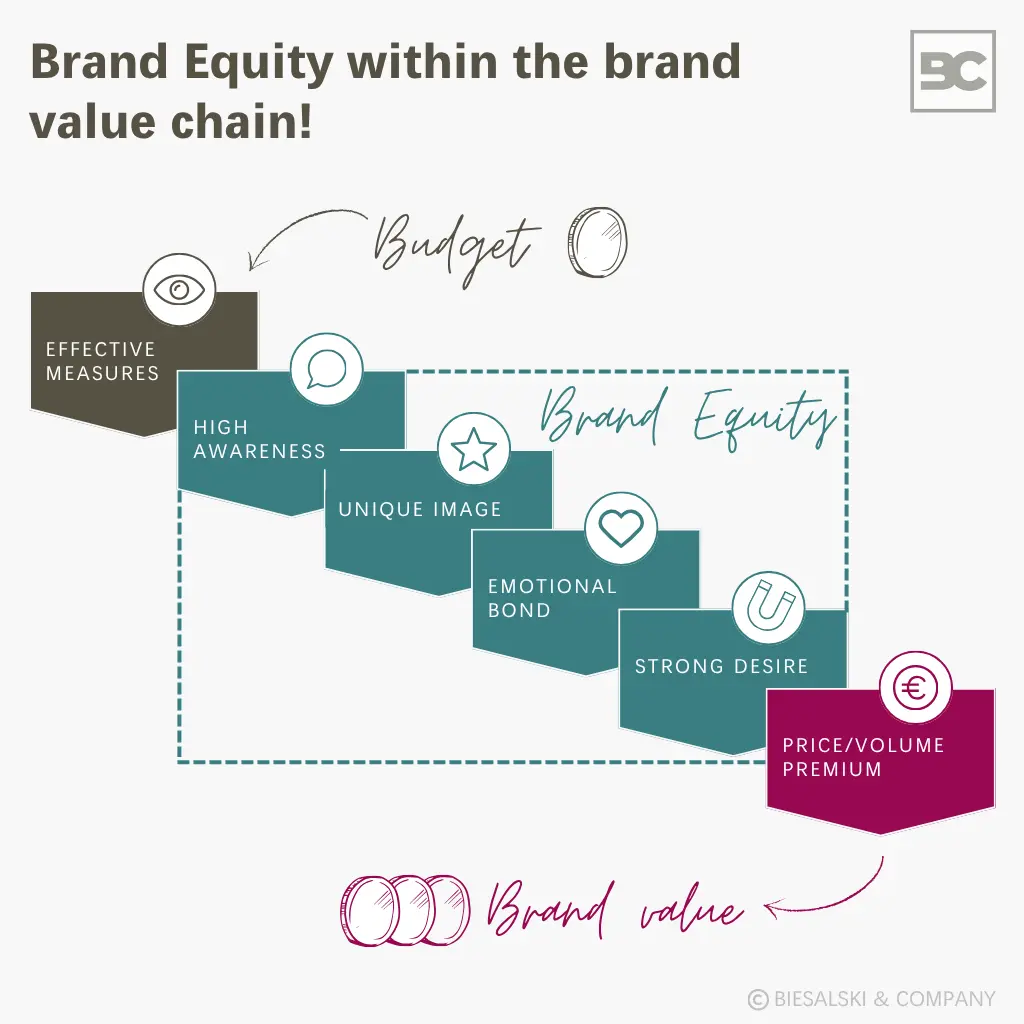
Brand Equity describes the value a brand adds to a product or service. It is created through factors such as brand awareness, brand associations, emotional connections and the resulting desirability of a brand. Brand Equity becomes evident when customers respond differently to a branded offering than they would to a comparable unbranded offering or one carrying a different brand.
Why is Brand Equity important?
Brands influence consumers through their awareness, the associations linked to them and the resulting customer responses. When these responses are favourable to the brand, it has positive Brand Equity. Conversely, a brand can also deter customers, indicating negative Brand Equity. Positive Brand Equity can therefore be a decisive competitive advantage.
What is Aaker's Brand Equity Model?
David A. Aaker defines Brand Equity as the set of assets and liabilities associated with a brand that can increase or decrease the value of a product or service. These can be divided into five key categories:
- Brand Loyalty: The degree of customer loyalty to a brand.
- Brand Awareness: The extent to which a brand is known and recognised.
- Perceived Quality: The perceived quality of a brand compared with alternatives.
- Brand Associations: The perceptions, attributes and emotions associated with a brand.
- Other Proprietary Brand Assets: Additional brand-related competitive advantages, such as trademarks, patents or special relationships with distribution partners.
The model therefore illustrates the components that can contribute to Brand Equity.
What is Customer-Based Brand Equity?
Customer-Based Brand Equity (CBBE), developed by Kevin Lane Keller, is a customer-centric model of Brand Equity. CBBE describes the differential effect of brand knowledge on consumer responses to marketing mix activities.
According to Keller, brand knowledge consists of:
- Brand Awareness
- Brand Image
- Favourability of brand associations
- Strength of brand associations
- Uniqueness of brand associations
CBBE therefore results from both brand awareness and brand image. Brand image, in turn, is shaped by the favourability, strength and uniqueness of the associations linked to a brand.
How does Brand Equity work in practice?
Coca-Cola is one of the world’s best-known brands. Many consumers associate the brand not only with the product itself but also with certain perceptions, experiences and emotions. Take a moment to reflect on what you personally associate with this brand.
Now imagine a specific purchasing situation: you are in a supermarket and want to buy a cola. You are faced with two products from different brands that are identical in terms of price and functionality. Would your associations with Coca-Cola lead you to choose Coca-Cola, or would they make you less inclined to buy it?
If your associations with the brand lead you to choose Coca-Cola, this indicates positive Brand Equity. If these mental associations have the opposite effect, this suggests negative Brand Equity. If the brand has no influence on your decision, there is little or no discernible brand-related effect in this situation.
In reality, purchasing decisions also depend on factors such as price, availability and product characteristics. Brand Equity therefore does not explain the entire purchasing decision, but rather the additional influence a brand has on perception, preference and behaviour.
What is the difference between Brand Equity and Brand Value?
The terms Brand Equity and Brand Value are often mistakenly used interchangeably. Brand Balue refers specifically to the monetary value of a brand. This can be determined using various valuation methods. In practice, cost-based, income-based and market-based approaches are commonly used to determine Brand Value.
How does Brand Equity work?
Brand Equity is shaped by the sum of all experiences with a brand. Once established, strong Brand Equity also influences how new information and experiences relating to the brand are perceived and evaluated. Positive and consistent brand experiences can therefore strengthen Brand Equity over time, while negative and inconsistent experiences can weaken it.
How can positive Brand Equity be built?
Positive Brand Equity is built over time through clear positioning, consistent brand experiences and products or services that deliver on the brand promise. The key is to build brand awareness while creating relevant, distinctive and credible brand associations. These associations must be repeatedly reinforced through positive experiences.
How can Brand Equity be measured?
Brand Equity can be a driver of monetary Brand Value and can also serve as the basis for an income-based monetary brand valuation. In addition, Brand Equity can be measured using indicators such as brand awareness, brand desirability and customer loyalty. The most appropriate metrics and measurement methods depend on the objectives of the assessment and the specific circumstances of the brand.
Contact
Would you like to discuss this topic with us? Our experts would be delighted to assist you – you can book an appointment conveniently here.
Sources & further reading
Aaker, D. A. (2022). Brand equity vs. brand value: What’s the difference? Prophet.
Keller, K. L., & Swaminathan, V. (2020). Strategic brand management: Building, measuring, and managing brand equity (5th ed., Global ed.). Pearson.
Keller, K. L. (1993). Conceptualizing, measuring, and managing customer-based brand equity. Journal of Marketing, 57(1), 1–22.