

Brand Management
What is Brand Management?
Brand management encompasses all the strategic and operational measures that companies use to analyse, position, manage and develop a brand. The aim is to establish a clear brand identity, a consistent brand perception and a competitive advantage. In this way, brand management helps to build trust, brand preference and long-term brand value.
Why is Brand Management important for business?
Brand management is important because brands play a key role in differentiating products in many markets. As products, services or technologies become increasingly similar, a strong brand provides guidance and builds trust. It helps target groups to assess offerings more quickly and make decisions with greater confidence.
For companies, professional brand management can deliver a number of benefits: it increases brand recognition, helps to put the customer at the heart of the business, supports clear positioning within the competitive landscape, and can contribute to brand value in the long term. At the same time, brand management also has an internal impact: a clearly defined brand provides guidance for employees and fosters a shared understanding of what the company stands for.
Brand management is particularly relevant in the B2B context because purchasing decisions are often complex, long-term and involve risk. Trust, credibility and the associated reputation management therefore play a particularly important role. A consistently managed brand can help reduce uncertainty and reinforce perceptions of competence, reliability and future viability.
What are the responsibilities of Brand Management?
Brand management encompasses a range of strategic tasks that collectively contribute to the long-term management of a brand. The focus is not only on the brand’s external image, but also on ensuring that the brand is consistently aligned across all relevant areas of the company:
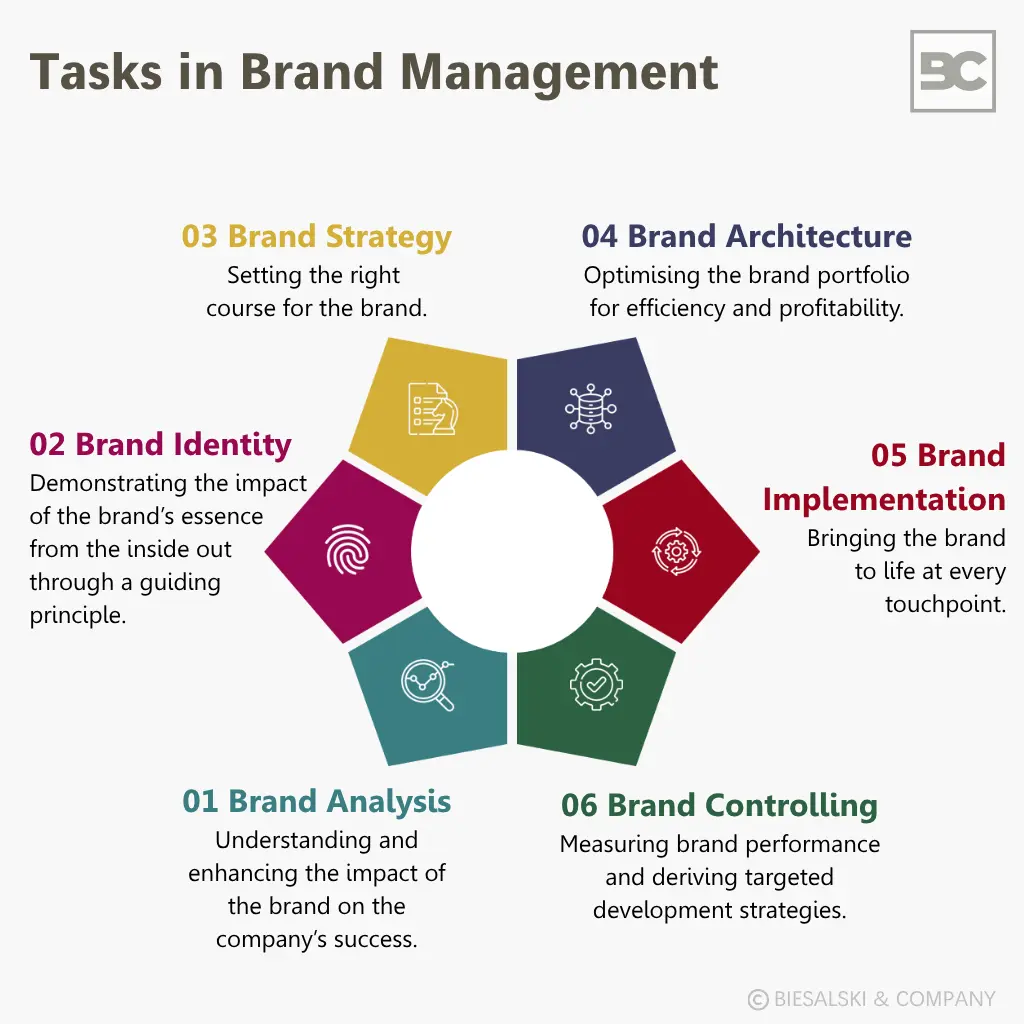
- Brand Analysis
Professional brand management begins with an analysis of the current situation. This includes the brand’s perception in the market, the expectations of the target groups, the competitive landscape, and internal strengths and weaknesses. Only on this basis can we determine where the brand stands and what brand development strategy makes sense.
- Brand Identity
Brand identity describes what a brand fundamentally stands for. Based on the brand mission and positioning, it sets out the brand’s core, long-term values, distinctive characteristics, credible expertise and unique self-image. These form the basis for all further decisions in brand management.
- Brand Strategy
Brand strategy defines the long-term direction of the brand. Among other things, it addresses which target groups to reach, which markets are relevant, what brand architecture makes sense, and how the brand should be developed in the future. It thus provides a framework for consistent decision-making and prevents individual initiatives from being planned in isolation from one another.
- Brand Architecture
Bei Unternehmen mit mehreren Marken, Produktlinien oder Geschäftsbereichen regelt die Markenarchitektur das Zusammenspiel der einzelnen Marken. Sie legt fest, ob Produkte unter einer Dachmarke, als Einzelmarken oder in einer kombinierten Struktur geführt werden. Ziel ist es, Orientierung für Kunden zu schaffen, Synergien im Markenportfolio zu nutzen und Überschneidungen oder Unklarheiten zu vermeiden. For companies with multiple brands, product lines or business units, brand architecture governs the interaction between the individual brands. It determines whether products are marketed under an umbrella brand, as individual brands, or within a combined structure. The aim is to provide clarity for customers, leverage synergies within the brand portfolio, and avoid overlap or confusion.
Brand Implementation
A brand strategy is only effective if it is implemented consistently. Brand implementation means bringing the brand to life at all relevant touchpoints – for example, in communications, sales, product design, service, employee behaviour and the customer experience.
Brand Controlling
Brand management also involves regularly monitoring brand performance. This includes metrics such as brand awareness, brand image, brand trust, brand loyalty, customer satisfaction and brand value. It is important to consider not only short-term sales figures, but also long-term, behaviour-related brand indicators. Brand value can serve as a key performance indicator in brand management.
Brand management is a key component of successful business management. It ensures that a brand is not created by chance, but is deliberately analysed, positioned, managed and developed. In doing so, it combines strategic decisions with operational implementation and regular performance reviews.
Professional brand management helps companies to refine their identity, distinguish themselves more clearly from the competition and build a consistent brand image among relevant target groups. Brand management is therefore much more than just communication or design: it is a long-term strategic task that can contribute to a brand’s stability, relevance and value growth.
How is Brand Management embedded within companies?
How brand management is actually structured and embedded within a company depends heavily on the industry, business model and brand structure.
In many companies, brand management is organised as a separate function, department or staff unit. However, the specific structure can vary: it is often part of marketing, corporate communications, product management, strategy or reports directly to senior management.
B2C consumer goods companies
For FMCG and consumer goods companies, brand
management is often closely tied to individual product or family brands. The
aim here is to make brands visible in highly competitive markets, build brand
recognition and quickly trigger purchasing preferences. Nivea, for example,
demonstrates how an established brand can be expanded into new skincare
categories over many years without losing its fundamental brand perception.
B2C durable goods companies
In the case of durable goods, brand management is
often more closely linked to product strategy, innovation, design, sales and
service. The purchasing decision is generally less impulsive than with FMCG,
and is instead influenced more by information, comparison and long-term use.
Multi-brand companies
For companies with numerous individual brands – such
as Ferrero, with brands including Nutella, Duplo and Rocher – brand
architecture also plays a key role: the individual brands must be clearly
distinguished from one another whilst also fitting into the overall logic of
the portfolio.
In the automotive and technology sectors in
particular, brand management must therefore ensure that product features, the customer
experience and the brand promise are all aligned. At the same time, challenges
arise when companies use platforms, components or technologies across multiple
brands for the sake of efficiency: in such cases, the brand must continue to be
perceived as distinct and unique, despite internal synergies.
B2B companies
In a B2B context, brand management takes on a different dimension. Here, the focus is often not on individual product brands, but on the corporate brand. Trust, reputation, technical expertise and reliability are particularly important, as purchasing decisions are often complex, long-term and involve significant investment.
The brand is therefore managed not only through communication, but above all through sales, consultancy, service, product quality and the behaviour of employees. Consequently, brand management in B2B companies is often more firmly embedded across departments and involves not only marketing and communication, but also sales, product management, HR, service and corporate governance.
The more a brand is seen as a strategic driver of value, the more important it is to embed it within the organisation at management level. Brand management then not only ensures a consistent external image, but also links brand strategy, internal implementation, customer experience and long-term value creation.
Sources & References
Keller K. and
Swaminathan V. (2020). Strategic Brand Management: Building, Measuring and Managing Brand Equity
(5th Global Edition). Pearson.
Esch F. (2019). Handbuch
Markenführung. Springer Verlag.
Contact
Would you like to have a no-obligation chat about this topic? Our experts are happy to help – you can book your preferred appointment here.