
Brand Marketing
What is meant by brand marketing?
Brand marketing is the area of marketing that focuses on the strategic building and development of a brand. Brand marketing is therefore not limited solely to marketing communications, but also encompasses the brand-consistent design of products, points of sale and all other relevant touchpoints along the customer journey.
What exactly is brand marketing about?
Strategic brand marketing generally pursues 4 goals:
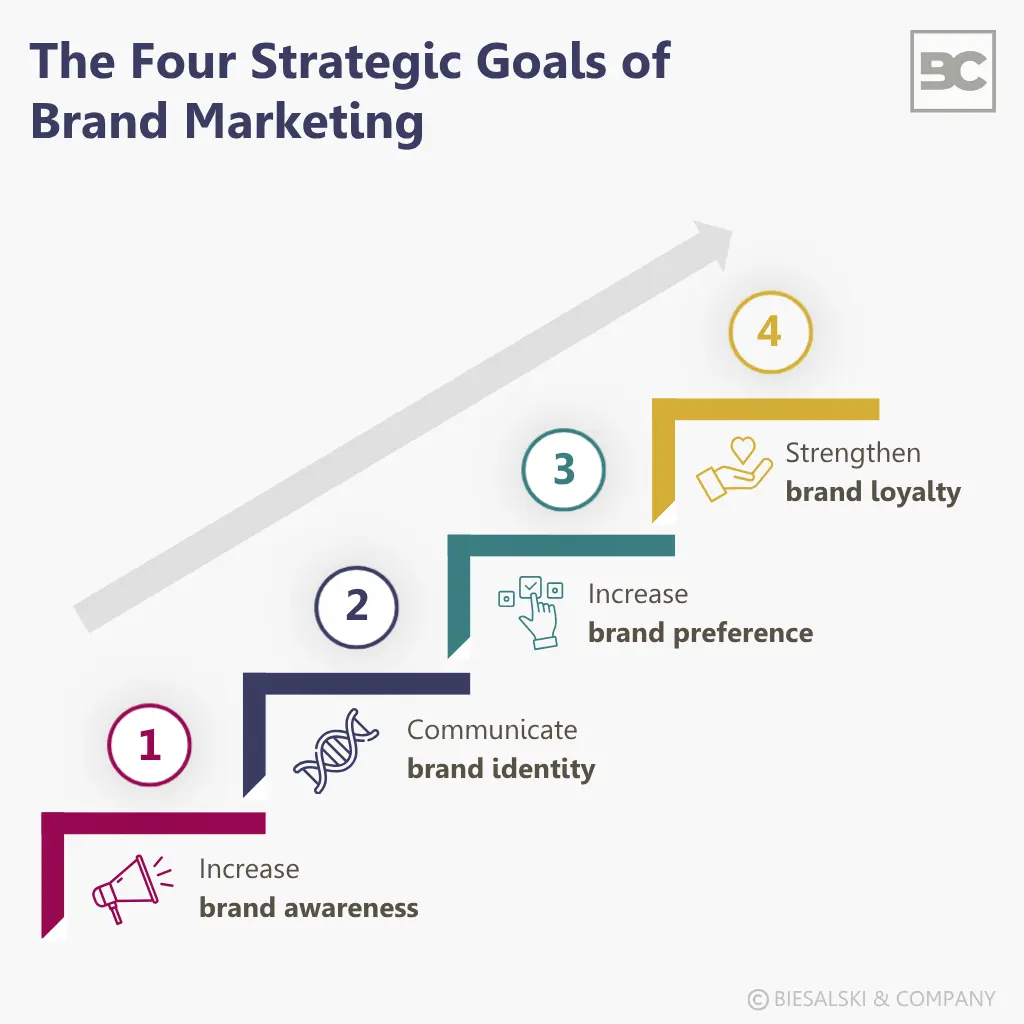
1. Increasing brand awareness:
the goal of increasing brand awareness is to familiarize new target groups with a brand beyond its existing customer base, without necessarily communicating specific brand content. Examples include perimeter advertising during the FIFA World Cup or sponsoring major music festivals.
2. Communicating a clear brand identity:
the focus here is on clearly conveying to customers which values the brand stands for. In commercials by major beer manufacturers, for example, associations such as freedom or a sense of community may form part of the brand identity, while automobile manufacturers may emphasize quality, safety, or driving pleasure.
3. Increasing brand preference:
this is the stage at which brand marketing is intended to influence customer behavior in the long term. Especially in situations of uncertainty or limited expertise, consumers are more likely to choose brands they are familiar with or associate positively with. This is often because brand names such as Miele or Siemens are linked to a quality promise built over many years.
4. Strengthening brand loyalty:
strong brands have more loyal customers – therefore, strategic brand marketing also targets existing customers. A good example is Apple’s 2015 campaign: “If it’s not an iPhone, it’s not an iPhone.” Here, the value of being part of the Apple community is deliberately used to strengthen brand loyalty.
How does brand marketing differ from other forms of marketing?
Brand marketing differs from performance marketing, which focuses less on the long-term impact of marketing through the brand and more on short-term sales growth through targeted marketing activities.
How do you create a brand marketing strategy?
1. Define a clear brand positioning:
this step answers the question of what the brand wants to offer its customers. It is important that the brand promises only what the company, product, and service can actually deliver. For example, Amazon’s brand value “Customer first” is reflected in, among other things, an internal logistics system with guaranteed delivery times and generous return policies.
2. Establish the brand identity and appearance:
the main objective here is to create strong brand recognition. This is achieved through a clearly identifiable logo combined with a defined color scheme. Consistent use of the logo and color scheme across all touchpoints forms the foundation of a coherent brand perception. Particularly prominent examples include the Nike “Swoosh” and “Coca-Cola Red,” both of which have remained unchanged for years and therefore contribute significantly to brand recognition.
3. Align the product portfolio:
a consistent brand marketing strategy also provides guidelines for the company’s product portfolio. This includes translating brand values into product features (e.g., how is “Vorsprung durch Technik” reflected in an Audi vehicle?) as well as differentiating product features between different brands within a parent brand (e.g., how should a Ritz-Carlton hotel differ from a Sheraton hotel within the Marriott brand portfolio?).
4. Analyse and design relevant touchpoints:
identifying and consistently designing all relevant touchpoints in line with the brand identity is considered the gold standard of brand marketing. In a brand-oriented company, all business units understand what the brand stands for and therefore act as drivers of the brand experience. In this context, BIESALSKI & COMPANY has established the perspective of the brand as a value creation system.
Contact
Would you like to dicuss this topic with us? Our experts are gladly available – you can conveniently book an appointment with us here.
Sources
Binet, L., & Field, P. (2018). Effectiveness in Context: A Manual for Brand Building. Institute of Practitioners in Advertising.
Sharp, B. (2010). How Brands Grow: What Marketers Don’t Know. Oxford University Press