

Performance Marketing
What is Performance Marketing?
Performance marketing is a data-driven strategy within digital marketing. Its goal is to make the success of campaigns measurable. The focus is on trackable interactions with the target audience across digital touchpoints. These interactions form the basis for evaluating and optimizing marketing activities.
Unlike traditional channels such as TV or print, performance marketing primarily focuses on digital channels like websites or social media. Here, user interactions can be tracked with precision, including clicks (e.g. page views), leads (e.g. contact inquiries), or conversions (e.g. purchases).
To evaluate performance, companies use Key Performance Indicators (KPIs). These make the impact of individual measures transparent and help allocate budgets to where they deliver the greatest effect. Typical KPIs are click-through rate (CTR), conversion rate (CR), and cost per click (CPC).
The relevance of this approach is also reflected in investment levels: in 2024, around USD 667 billion were spent on digital marketing worldwide. By the end of 2026, this figure could exceed USD 750 billion. As of today, more than half of this spending is attributed to performance marketing.
What types of Performance Marketing exist?
Performance marketing offers a wide range of instruments. The most important include:
Search engine marketing:
Search-based measures reach users exactly when they are actively searching for information, products, or solutions on platforms like Google. This includes search engine optimization (SEO) and search engine advertising (SEA). Generative Engine Optimization (GEO) complements this approach by making content visible in AI-generated search results on platforms such as ChatGPT or Perplexity.
Display and affiliate advertising:
Display advertising includes digital ads in the form of banners, images, or videos that are placed on websites or platforms. A common form is affiliate marketing, where companies collaborate with partner sites that provide ad space and are compensated for successfully generating clicks, leads, or sales.
Paid social or content advertising:
Social media and content marketing also play a central role in performance marketing. Companies use platforms such as Instagram, LinkedIn, or TikTok to distribute content and target specific audiences. Informative, entertaining, or inspiring content can drive interactions and motivate users to take concrete actions such as clicks, leads, or purchases.
How do you develop a Performance Marketing strategy?
Developing a performance marketing strategy can be divided into four typical phases:
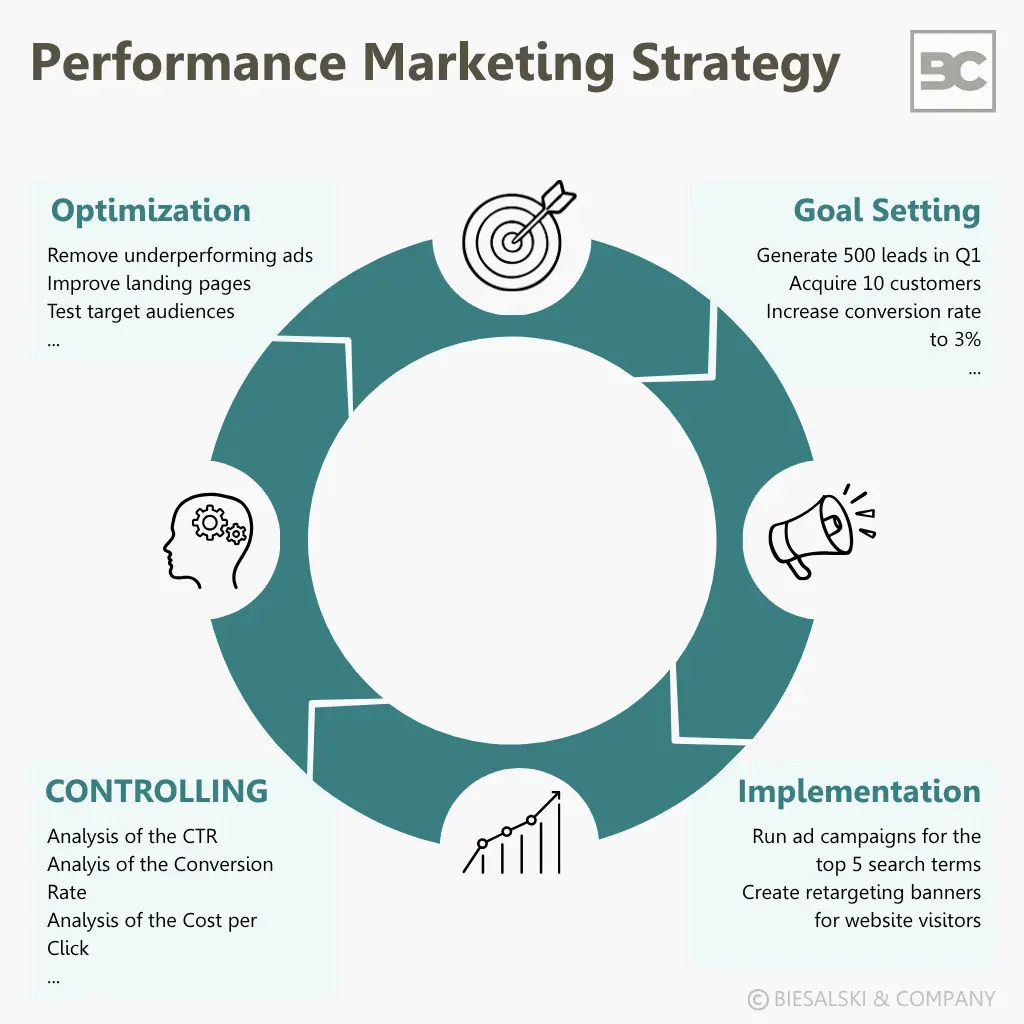
1. Goal Setting:
Goals should be specific, measurable, achievable, relevant, and time-bound (SMART). For example, a company might aim to generate 500 new leads through digital campaigns within one quarter or increase the conversion rate of an online shop from 2% to 3%.
2. Implementation:
In the next step, suitable marketing channels and campaign formats are selected to achieve the defined goals, such as affiliate marketing or search engine marketing. What matters is that all activities ultimately remain measurable.
3. Controlling:
Campaign results are continuously evaluated based on defined KPIs. Companies analyze metrics such as click-through rate, conversion rate, or cost per click to assess whether the marketing goals are being achieved.
4. Optimization:
This is the defining characteristic of performance marketing. The collected data is not only monitored but also interpreted. Based on these insights, campaigns can be adjusted, budgets reallocated, or creatives refined to achieve marketing goals more efficiently.
However, performance marketing does not end with this step. Once processes have been optimized, the next step is to set new goals. Performance marketing is therefore an ongoing discipline that enables campaigns to be continuously improved in terms of efficiency.
Advantages of Performance Marketing
- Continuous optimization
Through ongoing analysis, performance marketing enables continuous improvement of results. Marketing activities can be regularly adjusted and optimized based on the insights gained.
- Targeted audience approach
Performance marketing enables companies to address the specific needs of their target audience and develop tailored campaigns. This is primarily driven by the wide range of available channels (e.g. SEO, SEA, email marketing, etc.).
- Low risk and budget efficiency
Costs are often incurred only upon success (e.g. payment per click, conversion, or lead). This allows companies to allocate their budgets to the channels that deliver the greatest impact. As a result, performance marketing also reduces overall marketing risk.
- High transparency and data-driven decision-making
Since all campaigns are measured using clearly defined metrics (KPIs), companies gain detailed insights into the effectiveness of their marketing activities. This allows them to better understand which initiatives are working and which are not, and to adjust their marketing strategy accordingly.
Overall, performance marketing enables companies to manage their marketing activities in a more data-driven way and to measure their impact transparently. When applied effectively, it provides the foundation for more efficient marketing decisions and the continuous improvement of campaigns.
Practical examples of Performance Marketing
- Booking.com:
Booking.com is considered one of the most prominent examples of data-driven marketing. The company consistently bases its marketing decisions on performance metrics and continuously tests different variations of its digital touchpoints. At any given time, Booking.com runs hundreds of A/B tests to systematically optimize website elements, ad formats, and user interfaces. This approach has enabled the company to continuously improve conversion rates and further develop its marketing activities in a data-driven way.
- Spotify:
Spotify also makes extensive use of performance marketing, particularly in its digital advertising campaigns. A key focus lies on acquiring new app users and increasing premium subscriptions. To achieve this, the company uses targeted online advertising and regularly tests different ad formats, landing pages, and call-to-actions based on user data. Through this data-driven optimization, Spotify has been able to significantly reduce acquisition costs in several markets while further increasing the growth of its monthly active users.
Sources & further reading
DataReportal. (2025). Digital 2025: Global advertising trends. https://datareportal.com/reports/digital-2025-sub-section-global-advertising-trends
Datenbasiert.de. (2026). Performance-Marketing: Kompletter Leitfaden. https://datenbasiert.de/performance/performance-marketing/
Harvard Business Review. (2017). A refresher on A/B testing. https://hbr.org
Haufe Akademie. (2024). Performance Marketing: Definition, Strategie und Vorteile. https://www.haufe-akademie.de/blog/glossar/performance-marketing/
HubSpot. (2024, August 23). Performance Marketing: Definition, Strategie, Vorteile. https://blog.hubspot.de/marketing/performance-marketing
Interactive Advertising Bureau. (2023). Internet advertising revenue report: Full year 2022. https://www.iab.com
Journal of Digital Market and Digital Currency. (2025). Journal of Digital Market and Digital Currency, 2(1), 26–45. https://doi.org/10.47738/jdmdc.v2i1.27
Kemp, S. (2025). Digital 2025: Global advertising trends. DataReportal. https://datareportal.com/reports/digital-2025-sub-section-global-advertising-trends
WordStream. (2026). 180+ powerful digital marketing statistics for 2026. https://www.wordstream.com