


CORPORATE STRATEGY

A strategy that brings all business functions together.

We create your strategic compass for the next five years – from vision to concrete action.

BIESALSKI & COMPANY brings your company’s objectives, business areas and strategic priorities together in a clear strategy. We clarify which objectives and growth opportunities to focus on – and what to leave aside. The result is a coherent strategy that guides decisions across your business and shapes your brand.

YOUR NEED

When a new strategy makes sense

You need to decide which growth opportunities and markets your company should focus on in the years ahead.

You face changes driven by megatrends, such as advances in AI or geopolitical shifts, and want to review your strategic direction.

You are planning a reorganisation or strategic realignment, while departments or business units currently pursue different priorities.

You need to translate your vision into firm objectives for the entire organisation.

You are planning numerous projects and investments and need to decide which take priority.

YOUR BENEFIT

What you gain

Make strategic decisions based on clearly defined objectives and priorities.

Assess your strategic direction against trends, competitors and target audience perspectives.

Understand how each action contributes to your strategic objectives.

Secure stakeholder commitment to your direction – including clear agreement on what you will not pursue.

Focus budgets and resources on the projects with the greatest strategic impact.

OUR METHODOLOGY

Why our approach works

01

VISION

Define your vision and business ambitions

Establish a firm direction for the long term

02

TREND ANALYSIS

Systematically analyse megatrends and industry trends

Identify future market opportunities

03

ALIGNING PERSPECTIVES

Compare internal and external perspectives

Identify potential conflicts early

04

CASCADING OBJECTIVES

Translate objectives into concrete measures

Clearly define how each department contributes to the overall strategy

05

PRIORITISATION

Assess profitability, urgency and customer value

Avoid investing in initiatives with limited strategic relevance

06

IMPLEMENTATION READINESS

Assess the gap between the current position and the desired outcome in each priority area

Plan the implementation effort realistically for each department

THE OUTCOME

What you receive

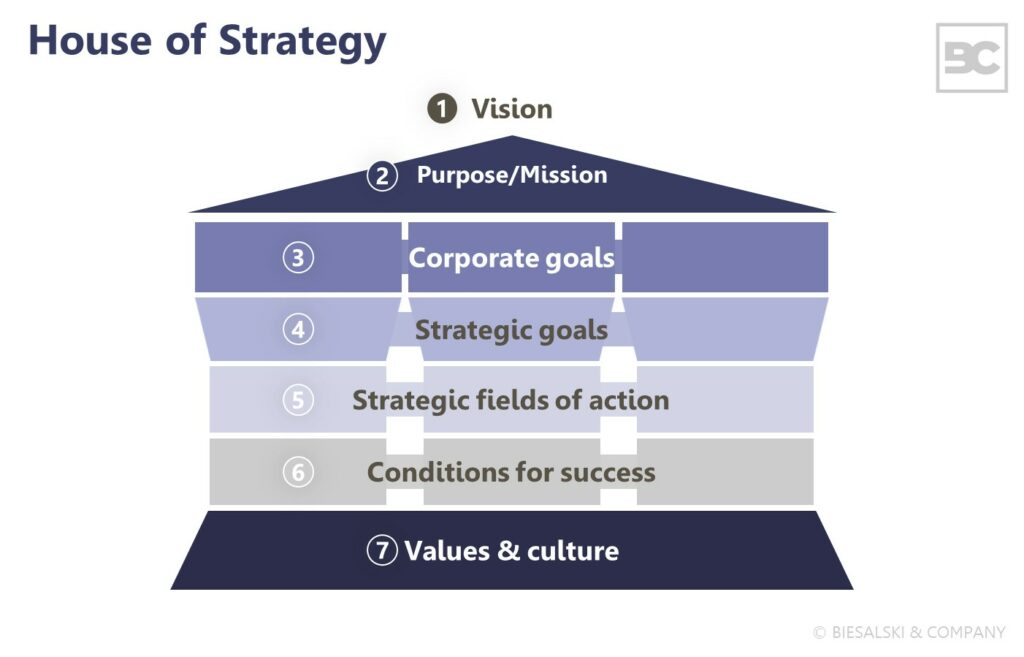
Brand strategy: 7 components for success

Simplified illustration

THE PROJECT PROCESS

How we work

Kick-off

Agree on objectives, project scope and participants

Current situation and trend analysis

Review internal documents and conduct in-depth trend research

Management interviews

Clarify business ambitions and define specific objectives

Target group research

Survey market participants, depending on project scope

Internal workshops

Translate strategic priorities into actionable plans and prioritise initiatives across departments

TOTAL DURATION: approx. 8–10 WEEKS

OUR REFERENCES

Why our clients trust us

We are the trusted partner to corporate brand teams and business units.

OUR EXPERTISE

The experience behind our approach

Years of strategic brand work
0 +
Successful strategy projects
0 +
Industries
0 +

YOUR CONTACT

Let’s discuss your challenges.

Alexander Biealski, Managing Partner und Inhaber von Markenberatung Biesalski & Company
Alexander Biesalski MANAGING PARTNER
I look forward to hearing from you.

FAQ

Frequently asked questions

How does corporate strategy differ from purpose and brand strategy?

Corporate strategy sets the direction for the company’s development over the coming years. It defines the objectives it pursues, the areas in which it aims to grow and the projects that take priority – across all functions, from sales and production to organisational development and HR.

Purpose, by contrast, describes the contribution the company makes to employees, customers and society. An existing purpose helps guide the strategy. If no purpose has been defined, it can be developed as a separate project.

Brand strategy builds on corporate strategy and clarifies how the brand contributes to its objectives.

Corporate strategy takes a medium- to long-term view and is not redeveloped every year. A strategic realignment makes sense when the existing strategy reaches the end of its planning horizon or when key assumptions about the market, competition or business model no longer hold.

When planning the project, consider your next planning and budgeting cycle. If the strategy is ready in time, prioritised initiatives can feed directly into investment decisions. In subsequent years, reviewing implementation and adjusting actions where necessary is usually sufficient.

We start with your existing documents, such as business plans, market information and relevant trend insights. We also draw on existing strategy papers, statements of vision, mission and values, and market studies.

You do not need to collect new data beforehand. Where the available evidence is insufficient, we supplement it with in-depth market and trend research or a survey of market participants, depending on project scope.

The quality and currency of the information matter more than the volume of documents. At the outset, we assess which assumptions remain valid and identify any gaps or inconsistencies.

The process centres on executive leadership, senior management and strategically relevant stakeholders, whom we involve through structured management interviews. Employees from relevant functions and markets also take part in the workshops.

The number of participants depends on the project scope and company structure. Your internal time commitment mainly involves providing documents, attending interviews and participating in workshops. B&C handles the analysis, consolidation and presentation of the findings.

The cost depends on the scope of work. Key factors include the depth of analysis – from reviewing existing documents to surveying market participants – the number of management interviews, the number and duration of workshops, and whether individual business segments require their own objectives and strategic priorities.

B&C offers different levels of scope: from a company-wide strategy with initial actions to a segment-specific strategy with projects prioritised in detail. Following an initial, no-obligation conversation, we can provide a transparent proposal on request.